
NBA Futures Implied Probability in the UK: Turning Fractional Odds into Market Forecasts
 Available in US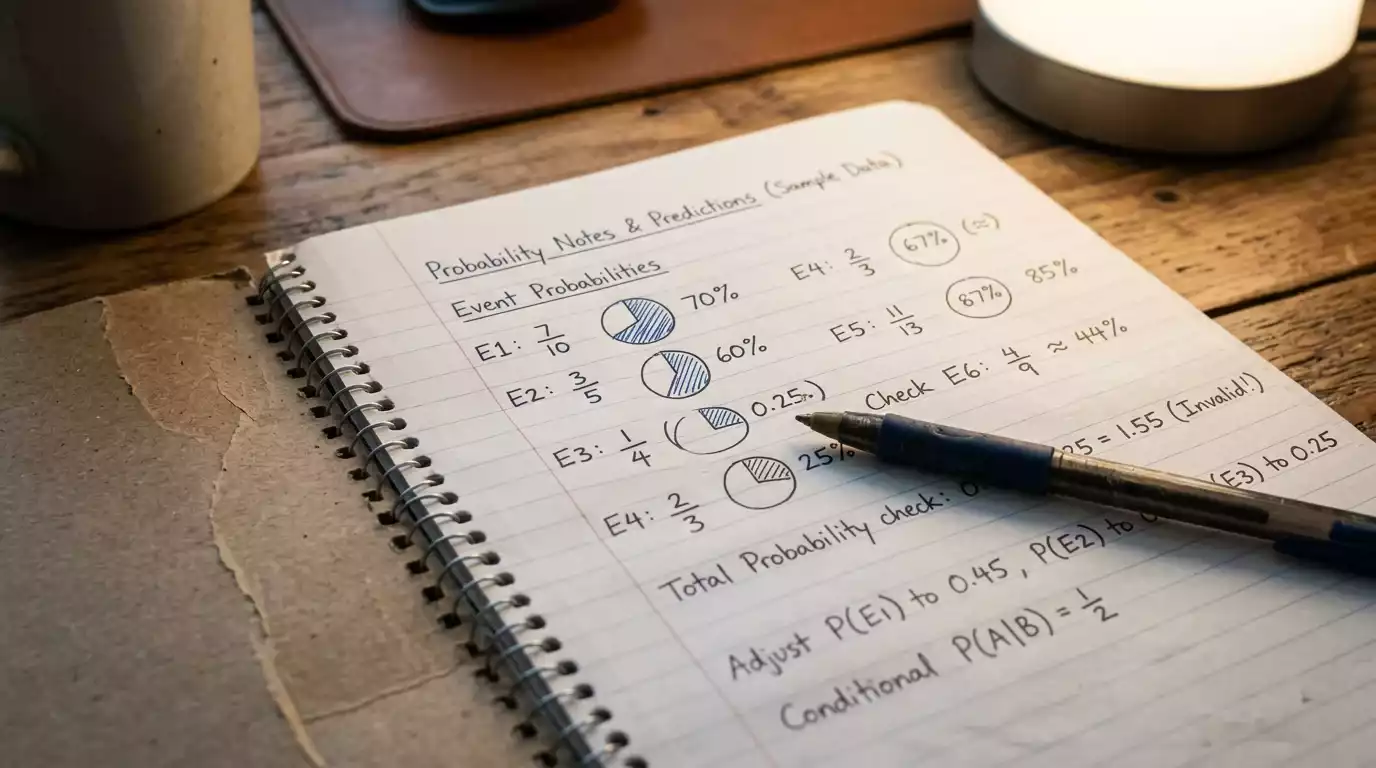
The conversion that beat my own intuition
Years ago I had a strong gut feeling about a 12/1 Championship contender. The team felt right — good defence, deep bench, healthy stars. I was on the verge of placing a meaningful stake when I forced myself to do the implied-probability conversion before pulling the trigger. The 12/1 price implied 7.7%. My honest estimate of the team’s actual title probability, written down without bias, sat at around 9%. The gap was real but slim, and once I subtracted the bookmaker’s overround the no-vig implied probability rose to roughly 8.4%. My edge was perhaps 0.6 percentage points. That was not enough to overcome variance on a single bet, and the maths told me to skip rather than play. The team made the Conference Finals and lost. The 12/1 ticket would have been a loser. The conversion saved me from a bet my intuition wanted me to place.
American sportsbook hold rates have climbed from 6.7% in 2018 to over 9% in 2024 and 2025. Every fractional UK price reflects that overround. Without converting price into probability and stripping out the margin, you are betting on feel — which is exactly how the bookmaker prices the books to extract their cut from the public.
The fractional-to-probability conversion in plain terms
UK bookmakers display NBA futures prices in fractions: 7/2, 8/1, 25/1, and so on. The fraction represents profit-to-stake ratio, and the implied probability is calculated as the second number divided by the sum of both numbers. A 7/2 price implies 2 ÷ (7 + 2) = 22.2%. An 8/1 price implies 1 ÷ (8 + 1) = 11.1%. A 25/1 price implies 1 ÷ (25 + 1) = 3.8%. The arithmetic does not require a calculator on simple prices; on tighter prices you should do the calculation properly rather than estimate.
Two specific cases to watch. First, prices below evens (1/2, 1/3, 4/9) represent favourites, and the same formula applies — a 1/3 price implies 3 ÷ (1 + 3) = 75%. Second, prices given as compound fractions (10/11, 9/4) sometimes confuse new bettors. A 10/11 price implies 11 ÷ (10 + 11) = 52.4%, just under evens. A 9/4 price implies 4 ÷ (9 + 4) = 30.8%. The principle does not change.
The reason this conversion matters more for futures than for match-day bets is duration. A futures bet is held for weeks or months, and the value of the original price is hard to evaluate without translating it into a probability you can compare against your own estimate. Once you have done the conversion, you are no longer evaluating a fraction against a feeling. You are comparing one probability number against another, which is a far cleaner mental task.
Adjusting for overround — the step most bettors skip
Add up the implied probabilities of every selection in a futures market and the total comes out above 100%. The excess is the bookmaker’s overround — the margin built into the prices to ensure the operator profits regardless of which selection wins. The overround is what separates the bookmaker’s prices from a fair-odds market, and stripping it out is essential to evaluating whether your own probability estimate offers genuine edge.
American hold rates over 9% and parlay margins exceeding 15% give you the rough scale of operator margin. UK NBA futures markets typically run with an overround between 110% and 125% — meaning the implied probabilities sum to that figure. To extract the no-vig implied probability for a specific selection, take the raw implied probability and divide by the total overround. A 7/2 price implying 22.2% in a market with 117% total overround translates to a no-vig implied probability of 22.2 ÷ 1.17 = 19.0%.
That number — 19.0% — is what the bookmaker actually thinks the selection’s probability is, after the margin. If your honest probability estimate is above 19.0% by a meaningful margin, the bet has value. If your estimate is below or only marginally above, the bet does not. The discipline of running this calculation on every futures bet you consider, before you place, is the single most important habit in long-term ROI.
Practical applications for UK ante-post bettors
“Dimers simulates NBA futures thousands of times and compares championship and conference odds across top sportsbooks — delivering the best prices and daily updated insights.” That kind of platform-level comparison rests on exactly the implied-probability framework above. The platforms identify value by comparing their internal probability estimates against the no-vig implied probabilities of each operator, and they flag the discrepancies that exceed a value threshold.
The same approach works for an individual UK bettor working manually. Maintain three numbers for every bet you consider: the raw implied probability from the bookmaker’s price, the no-vig implied probability after stripping out the overround, and your own honest probability estimate. Compare the third number against the second. The gap between them — your estimate minus the no-vig implied probability — is your edge in percentage points. Edges below three points are inside the noise of your own estimation error. Edges between three and seven points are worth pursuing at standard unit sizing. Edges above seven points are rare enough that they often signal an estimation error rather than genuine market mispricing.
The other practical application is across-market comparison. A team’s Championship outright price implies one probability; the same team’s Conference Winner price implies another; their Division Winner price implies a third. The three implied probabilities should be mathematically consistent — Conference probability should be higher than Championship probability, and Division higher again. When the relationship breaks, one of the three prices is mispriced. Identifying which one and acting on it is one of the cleaner edges available in this market. For the broader framework on comparing prices across operators and markets, the article at NBA futures odds comparison at UK bookmakers walks through the mechanics in detail.
Why does the sum of all implied probabilities in an NBA futures market exceed 100%?
The excess is the bookmaker’s overround — the margin built into the published prices to ensure the operator profits regardless of which selection wins. UK NBA futures markets typically run with overrounds between 110% and 125% depending on the specific market and operator. Larger fields and less liquid markets tend to carry higher overrounds, while heavily-traded headline markets like Championship outright sit at the lower end of that range. The 100% threshold corresponds to a fair-odds market, which does not exist in commercial sports betting.
What is a ‘no-vig’ implied probability and why is it useful for NBA futures bettors?
The no-vig implied probability is what the bookmaker effectively thinks each outcome’s probability is after stripping out their margin. To calculate it, divide the raw implied probability by the total market overround. Comparing your own probability estimate against the no-vig implied probability gives you a clean read on whether your bet offers real edge. If your estimate exceeds the no-vig figure by three percentage points or more, the bet has value worth pursuing at standard unit sizing.
Written by the editors at nba Futures Betting.